
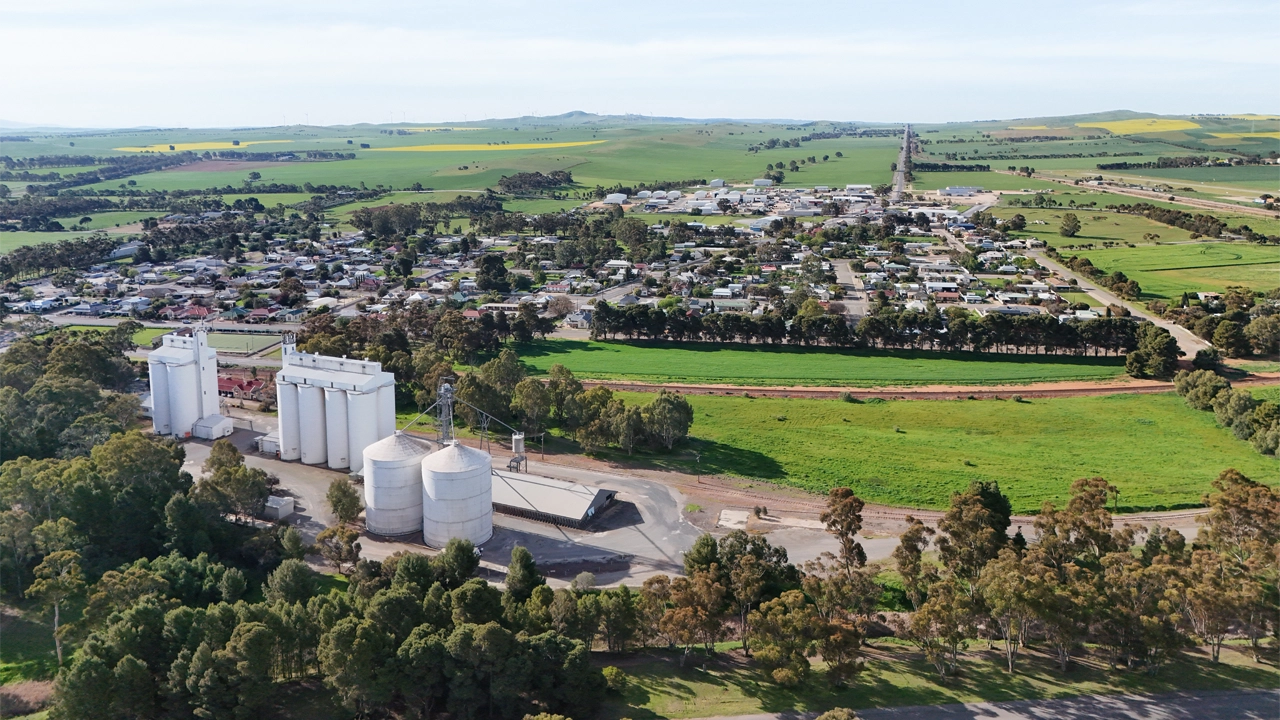
The town that nurtured RM Williams as a boy is a stable, many-faceted community that services the wider region.
Story + Photos Ken Eastwood
Drive unknowingly into Jamestown today, with its many shady gums lining Belalie Creek and main street, and you’d no doubt be flabbergasted to learn that when it was first surveyed in 1871, this town had only one tree. Situated on Ngadjuri Country, on what was an almost treeless plain 200km north of Adelaide, the town is now leafy, neat, peaceful and beautiful. Mallee ringnecks and apostlebirds flap through foliage, sheep graze contentedly on the edge of town, and neat gardens sit in front of single-storey brick houses with corrugated iron roofs and Federation-era buildings made out of local freestone that’s a warm orange in colour. And warming the heart, there’s the roadside untended Eddie’s Eggs stall, with an honesty moneybox inside.
From 1878, mayor John Cockburn (who later became SA Premier) began an extensive tree-planting program. Also that decade, planting began at what is called the birthplace of Australian forestry, Bundaleer Forest, on the outskirts of town. Mainly radiata pine, it’s still going today, although many of the trees are suffering after recent drought.
On the other side of town is the home of the only livestock saleyards in the north of SA, where – usually monthly – an average of 13,000 sheep are sold. “They all come in from the northern pastoral areas, West Coast, Mid North and the Adelaide Plains,” says Emily Cousins, sales support officer for Elders. “We don’t really get anything from Broken Hill anymore.” Operating since 1969, the mainly open, dirt yards now have cover over a new three-way scanning and drafting area. “It’s a big drawcard for the town,” Emily says. “The fuel station across the road asked me the other day when the next market was, because they’re flat out on market days.”
This story excerpt is from issue #167
Outback Magazine: June/July 2026