
A big, American-style ute has its charms.
Story Bruce McMahon
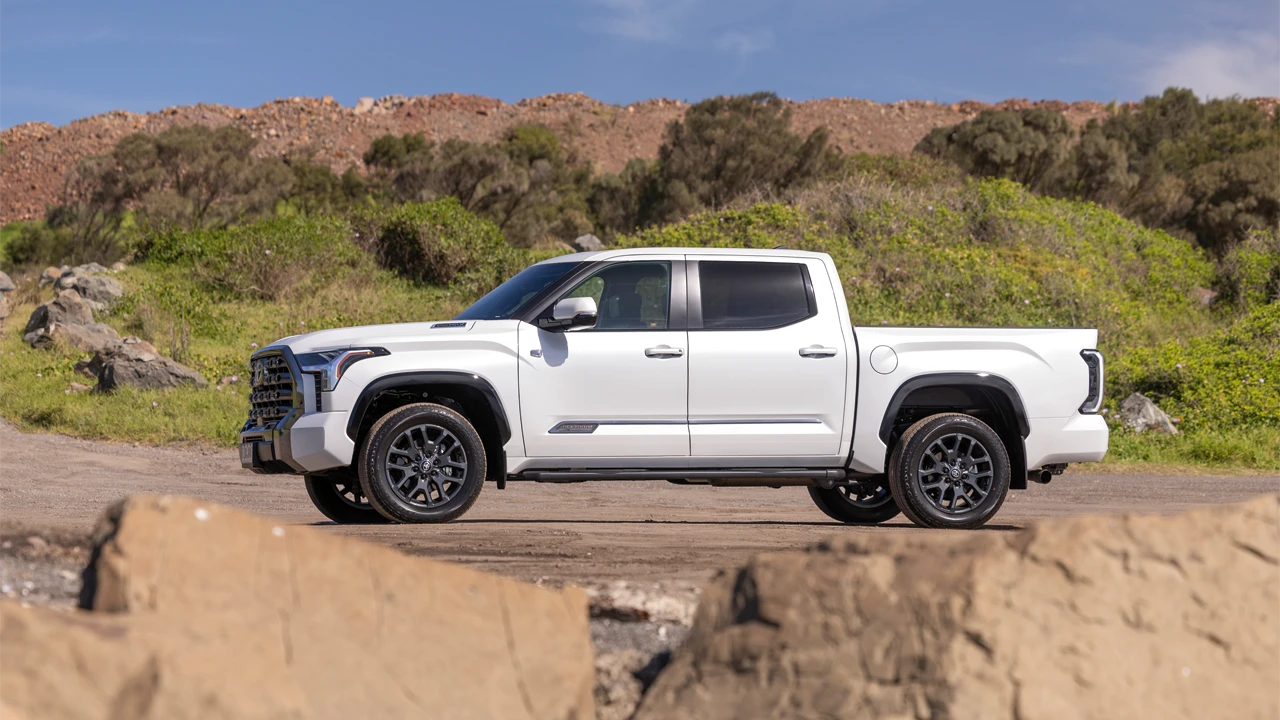
Toyota’s high, wide and rugged Tundra was born and bred to haul through the wide-open ranges. This full-sized pickup – aka ute – is one of the Japanese company’s brawniest, most expensive products, designed for the North American market to compete against light trucks from Ford, General Motors and RAM. Today, the third-generation Tundra is available in Australian showrooms, taking the sales fight to popular American rivals. Private importers have long converted American-built utes to right-hand drive, but since late 2024 the Tundra, re-engineered by Victorian-based Walkinshaw Automotive Group, has earnt Toyota’s official, and rare, blessing alongside a five-year factory warranty.
The hulking four-door, 4WD Tundra is built on the LandCruiser 300 wagon ladder frame chassis, with a longer wheelbase and wider track. It weighs in close to 3 tonnes, sits just under 6m long and just over 2m wide. That’s a big chunk of metal to park around town, yet surprisingly light to handle.
In Australia the Tundra is offered in two trims: Limited and Platinum, starting from $155,500 before on-road costs. It’s not the cheapest of the current American herd of pickups although it is the most powerful.
To shift loads in a hurry, the Texas-built Tundras run a twin turbocharged, 3.5L petrol V6 in parallel with an electric motor generator for a combined 326kW and 790Nm, working through a 10-speed transmission and dual range transfer case. The big hybrids are rarely found wanting from the get-go, laden or not. Both boast 4,500kg towing capacity, although the Platinum’s payload is restricted to 702kg.
For a big ute, the sidesteps are narrowish for climbing up into a wide, spacious cabin for five adults. A cluttered wealth of digital instrumentation takes time to digest, so the Platinum’s head-up display for speed and lane markings is appreciated and, from high in the leather saddle, forward visibility is generally good. The interior rear vision ‘mirror’ screens images from roof-mounted cameras and other cameras offer plenty of most-welcome vision in all directions.
Cabin conveniences include wireless phone charging, superb JBL sound system, barn loads of storage space and a 14-inch touchscreen for multi-media. While differences between the two models are largely confined to exterior cosmetics and extra seat features, one notable absence in the Limited edition is rain-sensing wipers.
While Tundras arrive with safety gear such as lane assist and collision avoidance systems, parking sensors and trailer sway control, there’s no traffic sign recognition to remind a driver of speed limits. This is a more notable absence in a big ute with the potential to cruise well beyond Australia’s legal limits.
This generation Tundra is the first to run without a V8 engine option, yet there are no complaints about this drivetrain’s work rate or how the electric motor and V6 combine seamlessly when all horses are needed. There’s silent running on electric when creeping around car parks and then there are those charming acoustics – deep, refined growls – of the V6 under full throttle. Engine and driveline responses encourage sporting drives down well-surfaced back roads and here it’s quite well-mannered for its size, turning into corners with enthusiasm and holding its ground, with some understeer to be expected. It lopes down the highway with ease, sitting around 1,500rpm for a reasonable 12L/100km – although it does ask for 95 RON petrol for the 122L tank. It’s only at slower speeds, say down a paddock track, where jiggles and muffled thumps may remind occupants this is a heavy duty, body-on-frame 4WD ute.
The Tundra’s bulk and 15m turning circle can be a hindrance in tight scrub, and weight could be a factor when tracks turn to slush. There’s 216mm of ground clearance, but 3,700mm between the axles to be considered. Even allowing for that well-geared low range, this is a 4WD best left to work in more open country.
Touring and towing are the Tundra’s principal strengths over load-carrying – a HiLux’s payload is up to 300kg better, while not matching the bigger Toyota’s 4,500kg towing capacity, huge cabin or ride comforts. Then there’s the Tundra’s grand price (around $180,000 for the Platinum on the road) to be considered. This is an expensive, albeit very good, American pickup. It’d be a pity to scratch those flanks out in the paddock.
Toyota Tundra from $155,500. For more information: www.toyota.com.au.
This story excerpt is from Issue #168
Outback Magazine: Aug/Sep 2026