
A 1,000km Top End round-trip in the wet season takes in extraordinary natural wonders, and you’ll have the place almost to yourself.
Story + Photos Ken Eastwood
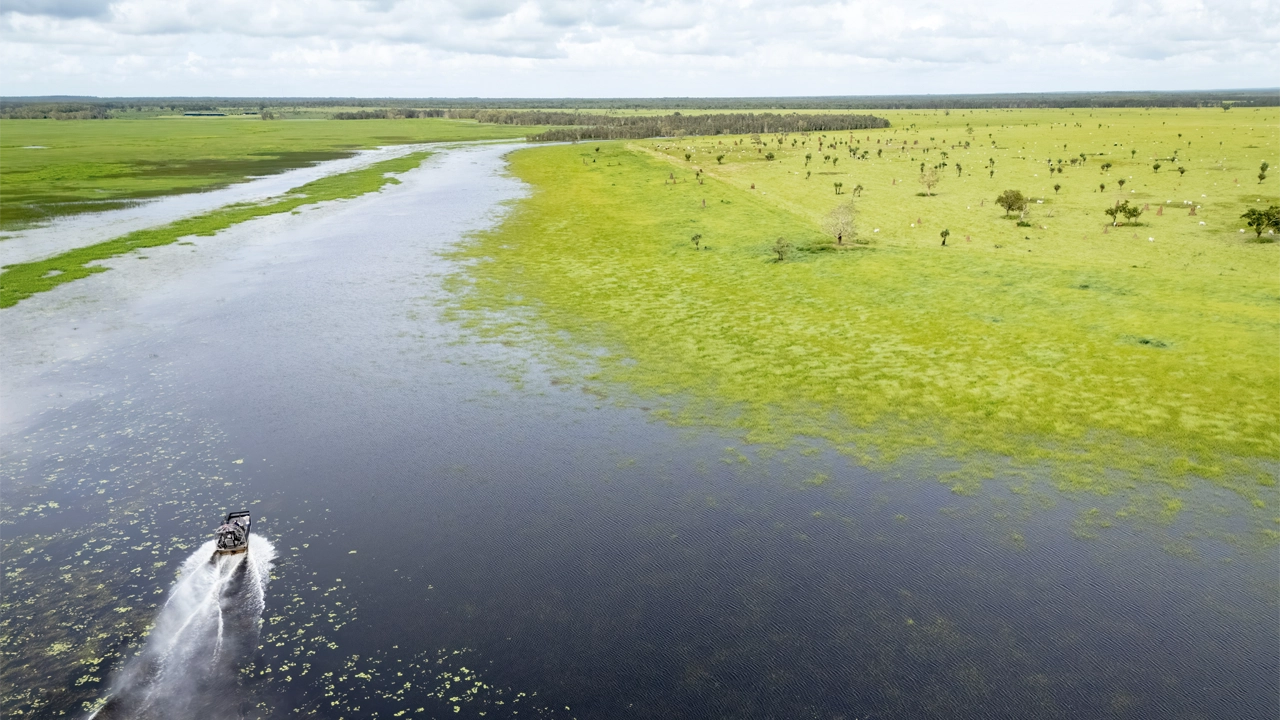
The skies are grey and brooding, but the water sodden paddocks are a lush green, as a 300-horsepower Holden Commodore engine races an airboat over Finniss River station, 100km south-west of Darwin. It’s the middle of the wet season and the airboat is a spectacular way to show guests around the station, from its paperbark swamps thick with birds to the slightly higher ground, where some of the 4,500 Brahman cross cattle are grazing among Cathedral termite mounds.
“We probably lose 30 cows a year to crocodiles – that’s the ones we know of,” says tour guide Peter ‘Fingers’ Taylor, at the airboat’s controls. “Usually, we try to keep them off the floodplains in the wet – we wait for the dry when they can get the green grass.”
Beside him is Olivia Venturin, manager of the luxury tourism venture here, and part of the third generation of Venturins who have called Finniss River station home. “In the dry season this is just a paddock – there’s no water here at all,” she says, as the airboat zooms across the vast humidicola grass and water plains. “People are scared to come to the Top End in the wet season. Sure, you get bugs and mozzies, but you get just as many in the dry season. I love how green everything is. It’s like a neon green. And there are dark, angry storms in the afternoon, the lightning’s pretty crazy and the fishing is good.”
Finniss River Lodge is one of many stellar reasons to go to the Top End in the wet season. If you’re prepared to be flexible, depending on flood and road conditions, it’s relatively easy to create a 1,000km road trip in and out of Darwin that will take in Litchfield and Kakadu national parks, almost without leaving the bitumen.
This story excerpt is from issue #167
Outback Magazine: June/July 2026