
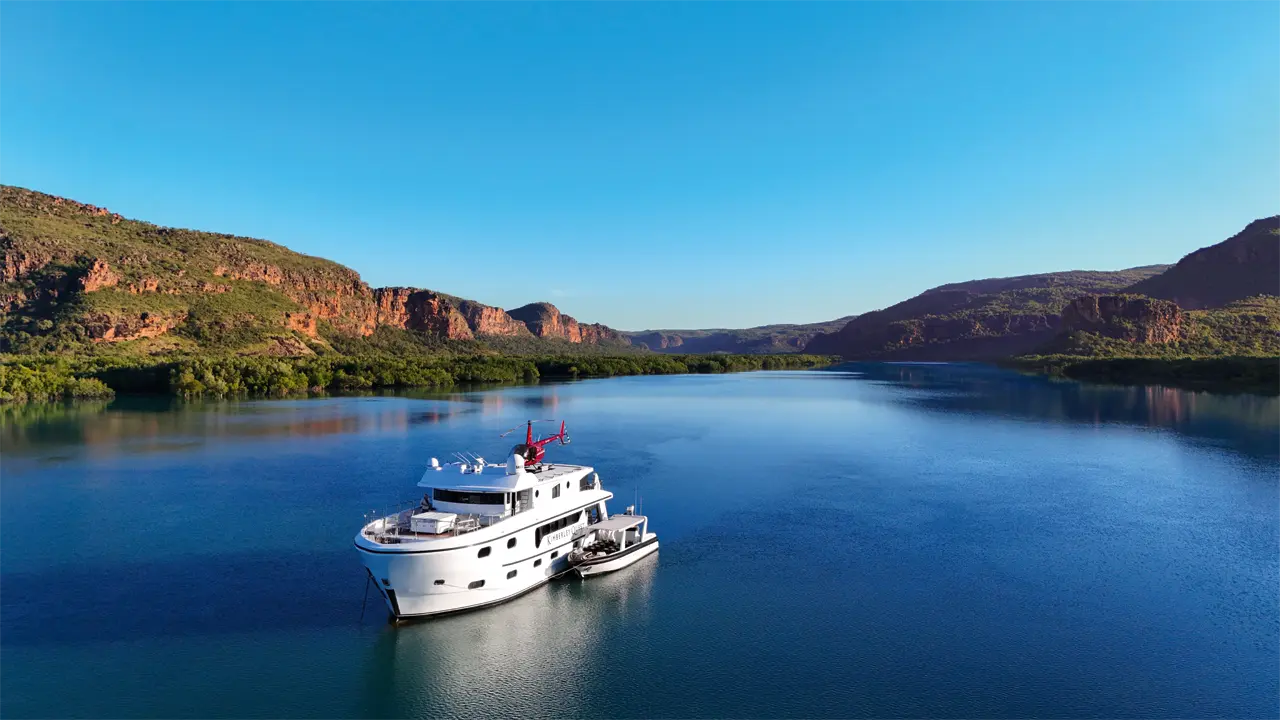
The Kimberley Quest is in her element exploring the stunning coastlines and waterways of Australia's north west.
Story + Photos Mark Muller
There are no tracks around the fat croc lying on a bed of rippled sand some 20km off the north-west coast of mainland Australia. Its scales are shining as bright sunlight plays across its ridged hide, unmoving in a light wind. The tides here rise and fall by as much as 10m, and so the vast repository of water in the central lagoon and channels of Montgomery Reef is always cascading on or off its edges.
The big saltie was probably floating happily – more than likely with a belly full of fish and turtle – as the massive tide dropped and he found himself sitting on the sand. As the apex predator of the region, not much is going to phase a large, mature crocodile unless it’s another, larger, crocodile ...
Overhead, the rhythmic chop of rotor blades draws closer, but old mate barely bats an eye as the helicopter dips low for a better view. At the controls, Joe Warriner guides the craft along the sandbar, eyes scanning the resting reptile, and the surrounding land, sea and air. It is day two of an eight-day journey along the Kimberley coast aboard the small expeditionary vessel Kimberley Quest II – early in the voyage, but already far enough in to appreciate just how far removed this place is from everyday life.
“He really doesn’t care at all that we’re here, does he!” laughs guest Sarai Beard from the back seat, leaning out the open door with her husband Kim Beard beside her. Joe grins through his moustache, banks slightly closer, then gently pours on the power and arcs away. He has logged more than 4,000 flight hours – mostly as a mustering pilot. Joe grew up on Carlton Hill station, mustering cattle before learning to fly. Now seconded from Fortescue Helicopters to the Quest, he relishes the change of pace. “The stock’s a lot easier to deal with, too,” he says with a twinkle in his eye.
The Quest is as at home in these waters as the basking crocodile. A 25m, custom-built ship, it carries just 18 guests in nine ensuite cabins, supported by a crew of seven, plus a dedicated pilot. Her design strikes a balance between functional practicality and relaxed comfort. The itinerary is mapped around key highlights, with the tide and guests’ interests shaping the where and when of much of the journey. Whether exploring wild river systems, discovering ancient rock art, fishing tidal creeks, or drifting beneath towering sandstone cliffs, there is a sense of camaraderie and collaboration that generates a positive energy all of its own. Evenings bring alfresco dining under the stars and friendly conversation in the fading light.
This story excerpt is from issue #163
Outback Magazine: Oct/Nov 2025