
Rebecca Huismann has turned a childhood setback into a career advantage in the disability sector in Moama, NSW.
Story Terri Cowley Photos Neil Newitt
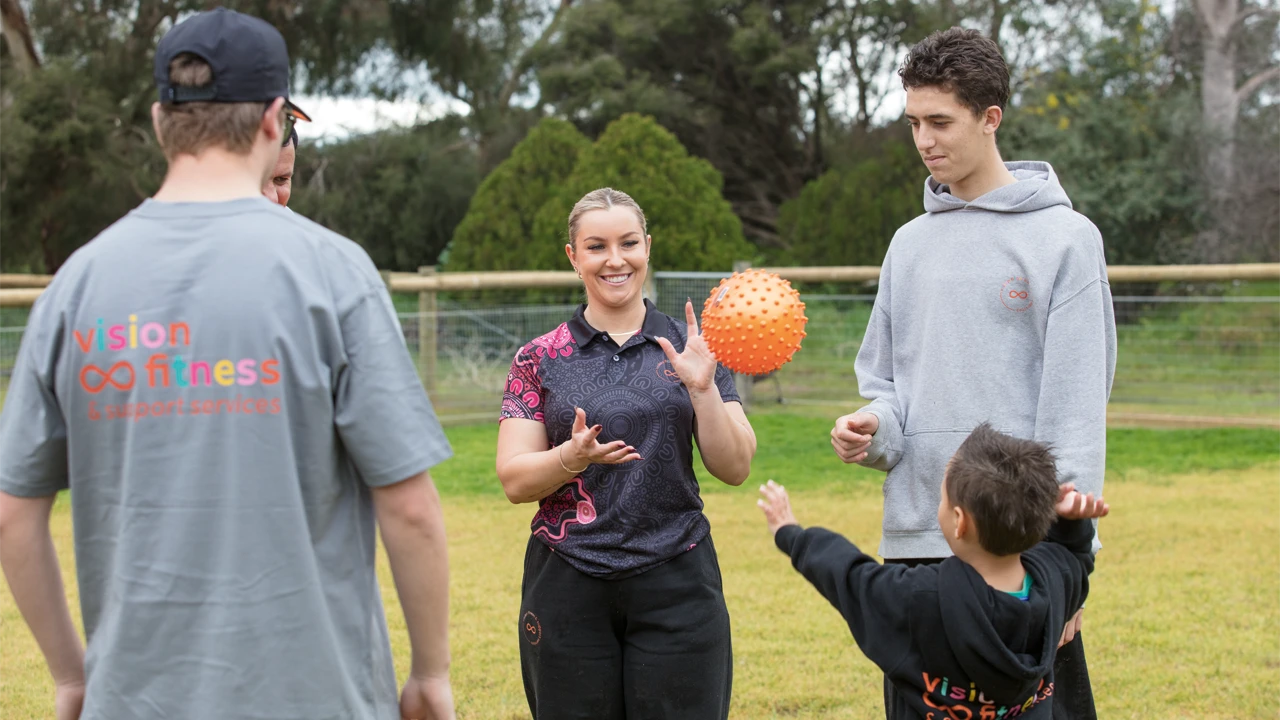
There’s a sense of organised chaos in Rebecca Huismann’s big backyard as a group of male clients takes part in various activities in the gentle winter sun. Some are helping set up a new trampoline; others are doing ball games; others are at a fence watching her small menagerie of farm animals – a trip of multicoloured goats and a woolly Merino called Rambo. All of them hang on Rebecca’s every word and, when they’re not doing that, they’re interacting with her mother Michelle, fondly known to all as Nan. Two large, fluffy chow chow dogs add to the sense of busyness.
Two years ago, Rebecca established Vision Fitness and Support Services – a disability service with a difference – in the NSW Murray River border town of Moama. “I wanted to set up a service for adults that didn’t feel like they were going to a service,” she says. “We run different programs Monday to Friday, including healthy cooking and fitness sessions. One day it’s maintenance, where those that can be are employed by community members to do lawns, for example. Another is basketball, and there’s a men’s shed day and a day with the animals. Most clients come five days a week and others whenever suits them.”
Although the schedule may not be that unusual, the difference is Rebecca. When she was 12 years old, she was having a horseriding lesson at her family’s property at Tongala in northern Victoria and the horse slipped. Despite wearing a safety helmet, she hit her head awkwardly. “I was lucky to survive,” Rebecca says. “I was put into a coma for several days. I didn’t remember anything before the accident.”
When Rebecca says she didn’t remember anything, she means anything at all – not just the circumstances of the accident. “When I woke up, that’s when I had to start everything all over again: speaking, toileting, showering, eating, walking, knowing who people were,” she says.
Rebecca had a remarkable recovery, to the point where you’d be hard pressed to know she’d ever had an accident. However, today at the age of 25, she continues to live with the consequences of an acquired brain injury (ABI). “It wasn’t so obvious at first because I was so young,” she says. “Things started to show when I was older. I struggle to process things sometimes. I can see a difference between an average person and me in taking in information. I don’t let people know I have an ABI. If people want to question why I don’t get something, that is on them. I don’t think I have to explain it to people.”
This story excerpt is from Issue #169
Outback Magazine: Oct/Nov 2026