
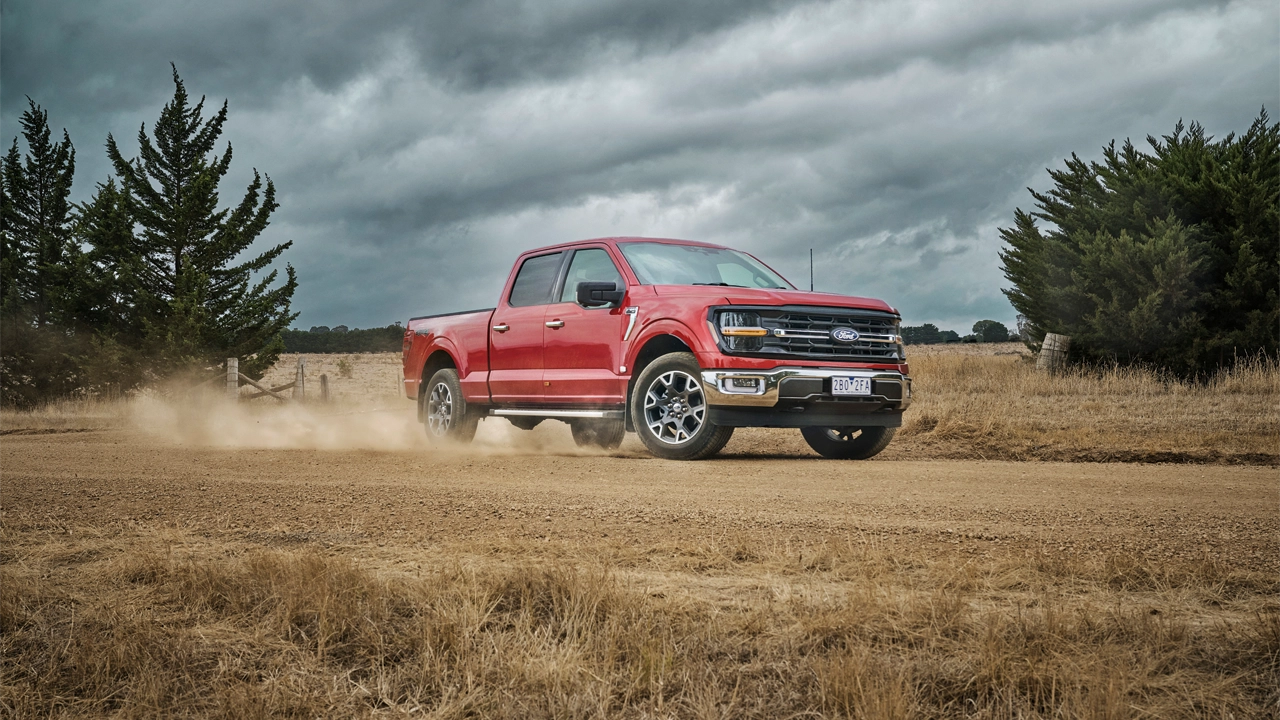
Ford’s F-150 is a big and tough piece of machinery, with a storied history across the world.
Story Bruce McMahon Photo Ford
Apart from a couple of gap years, Australia has been part of Ford’s F Series since it first landed in 1948. The F-150 arrived here in 1987, before being discounted six years later, then welcomed back as official Ford showroom product in 2024. This time the iconic Ford – America’s top-selling pickup – is converted to right-hand drive by RAM Automotive in Victoria.
The ‘remanufactured’ F-150s are backed by Ford’s official five-year warranty, with little to suggest these utes aren’t direct from a Ford factory floor (aside, perhaps, from an entry keypad on the passenger door). Much of today’s three days of conversion work revolves around adapting wiring harnesses and sensors, and hundreds of microchips for local drivers.
Attention to detail includes Australian speed and traffic sign recognition for Lariat and Platinum models.
Petrol and diesel V8 Fords are long gone, as is the ill-fated all-electric Lightning, yet today’s 14th generation F-150s are quicker, more comfortable and as capable as ever, with a 289kW petrol V6 up front. They’re thirstier than some work and play horses perhaps (even when not hauling a major load, it’s easy to run at 12–13L/100km), and filling a 136L fuel tank could be a running cost factor.
The 4WD F150s arrive as three distinct models in XLT, Lariat and now Platinum trims, all running the same mechanicals and with the choice of two wheelbases. The short wheelbase F-150 is the more popular here, with 3.6m between the axles, a 1.7m long tub and a body just under 6m. The long wheelbase version is just over 6m long, with 2m long tub on a 3.9m wheelbase.
All have been updated and upgraded, with the Platinum F-150 loaded with comforts and conveniences, from retractable sidesteps that emerge as the driver approaches, through to front seats – with massage options – that recline into a flattish bed. This sumptuous tourer also features continuously controlled damping, which adjusts shock absorbers to suit road conditions. The Platinum Ford is the most expensive, from $163,950, yet undercuts Toyota’s Platinum Tundra.
The F-150 Lariat runs with much of the Platinum’s gear, including full-time 4WD, wireless charging for phones, rain-sensing wipers and a tailgate that can be either swung open or dropped. On paper, these top two F-150s are more complete and more appealing (albeit dearer) than the latest F-150 XLT. However, the base model remains an engaging machine, even without all the features of big brothers.
For starters, as with all current Ford F-150s, the XLT’s cabin has been reworked and upgraded and now shares the 12-inch (30cm) touchscreen found across the range. Big cloth seats up front have powered adjustments, there’s dual-zone air, Apple CarPlay and Android Auto. Plus, there’s a fair swag of driver assistance, from blind spot monitoring to trailer sway control, tyre pressure monitoring system and a clever trailer back-up assist. The XLT’s exterior style, with less grille chrome than the other pair, looks more businesslike and the drop-down tailgate scores a handy, built-in step.
The most noticeable difference on the cheapest of the Fords is the auto transmission lever on the right-hand side of the steering column. It falls comfortably to hand and frees up work space on the huge centre console. To shift manually through the 10-speed gearbox with a button on the lever takes practice. For the most part, though, the Ford’s V6 power – even running in Eco mode – needs little help in making light of highway or paddock work. There’s 678Nm of torque to get off the line and the full 298kW arrives at 6,000rpm with the transmission slick and quick through the gears.
On 20-inch all-terrain tyres, the XLT is a quiet road runner and comfortable at speed over most conditions for a leaf-sprung, live rear axle ute. It turns in with some authority, holds its line and is confident out in open country. Six drive modes cover driving conditions from towing (up to 4.5 tonnes) to off-road. The XLT can be shifted into 4WD High on the move.
Modern Ford F-150s are big and comfortable enough for five adults, capable and easy to drive, yet best appreciated in wide open spaces. Even the SWB version, fitted with a tow hitch, just fits most council parking bays and it takes extra bites of steering turning that long body in traffic or among the trees.
These converted Americans are built for cruising, towing and carrying beyond city limits. 4WDing is best left to wide open beaches and paddocks. Considering the all-round capabilities, upfront prices are reasonable, but remember the extra fuel costs. All three Ford F-150s have appeal, yet it’s the XLT and its bigger payload of 853kg that deserves consideration as a workhorse.
This story excerpt is from Issue #169
Outback Magazine: Oct/Nov 2026