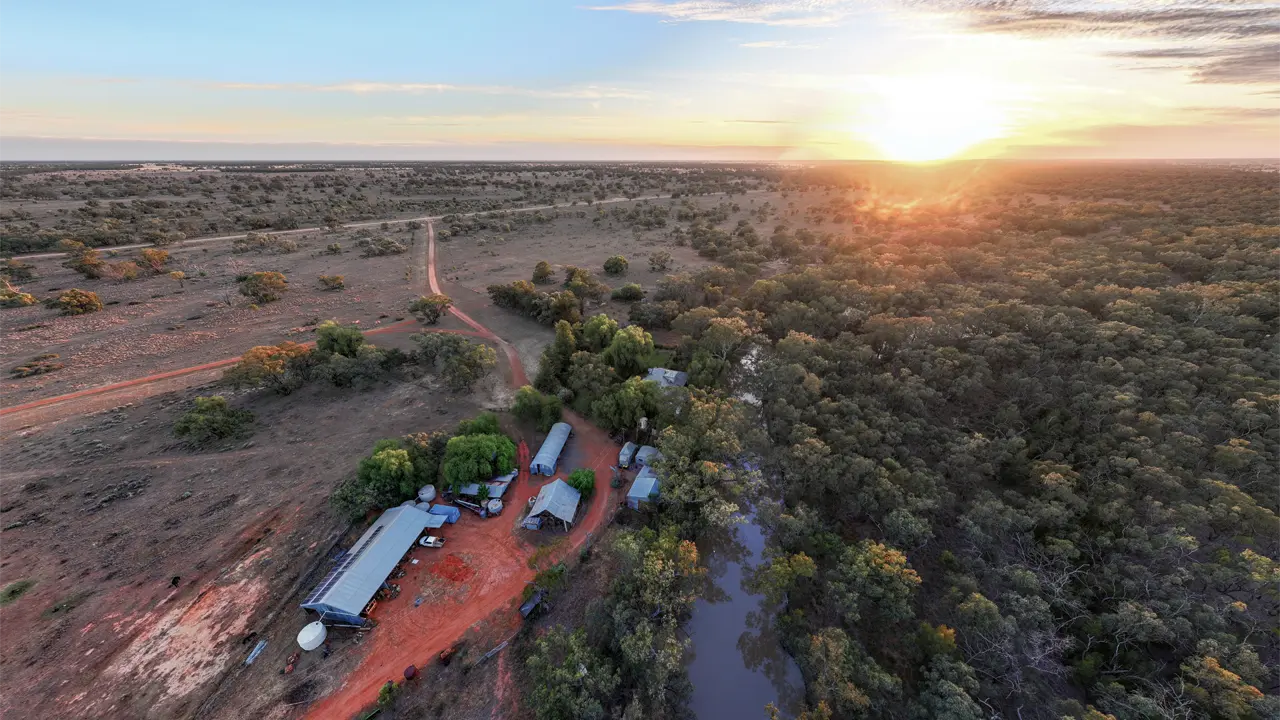


The 150-year-old Toganmain woolshed, one of the largest in Australia, is being lovingly restored by a community of volunteers.
Story + Photos Georgie Mann
At first light, the corrugated-iron walls of the Toganmain woolshed glow gold. The scent of sun-warmed lanolin rises from the boards and, in the early quiet, you can almost still hear it – the faint sound of boots on timber, voices over mugs of strong tea and the soft thrum of warming machines as sheep are yarded for the day’s shearing.
Dougie Newton was 20 when he first shore here. “It felt a bit like shearing royalty,” he says. “This was real shearing – full boards, fast runs. Coming from down south, it was exactly the work I’d dreamed of.”
Perched on the banks of the Murrumbidgee, east of Hay, Toganmain was built by shipwrights in 1875. It’s one of Australia’s grandest surviving woolsheds and still the largest in the NSW Riverina – 110 stands deep, stretching 73m long and 24m wide. Over 7 million sheep have passed over its boards. In 1876, it was the site of an Australian record: 202,292 sheep shorn by 92 blade shearers in a single shear.
Dougie speaks of it with reverence. “I had a real soft spot for this shed, and for all the years since, I’d always drive by if in the area.” For him, it was one of the great “wool cathedrals” – a place of industry, identity and pride.
But its sale from private to corporate ownership in the 1990s saw its use grind to a halt. Large-scale cropping replaced wool, and by 2023 the shed was derelict. The boards sagged. Iron clanged loose in the wind. A thick blanket of blow-away or windmill grass, dry as tinder, filled the interior.
Heritage architect Peter Freeman had long admired the shed’s unusual design and its inverted-ship structure. Watching its slow decline, he brought together a small group of people with ties to the wool industry, the land and its history. But as the shed continued to deteriorate, the group reached out to Christine Chirgwin, a local councillor with a reputation for getting things done, and urged her to visit.
“We were completely devastated,” Christine says. “The tin was off the roof, water had poured in, the stumps had sunk and the floor had collapsed in places. There was blow-away grass right up to the rafters – that stuff is like kerosene.” It confirmed what many had feared: Toganmain was one hot summer, or one strong wind, away from being lost forever.
What began with a few phone calls and old photographs shared over cups of tea soon gathered momentum. A band of volunteers began to form – shearers, farmers, historians, neighbours – all wanting to help preserve a piece of iconic Australian history. They called themselves the Friends of Toganmain.
This story excerpt is from issue #162
Outback Magazine: Aug/Sep 2025