
Ford adds a sophisticated petrol-electric hybrid to the Ranger line.
Story Bruce McMahon Photo Ford Australia
Ford Australia has a long and proud history in producing stand-out utes, continued today with the development of a sophisticated petrol-electric hybrid Ranger.
It was Ford’s Lew Bandt in the 1930s who designed the world’s first coupe utility, with passenger comforts up front and a cargo tub out back. Geelong engineers developed 4WD Falcon utes in 1972 and, later, the high-riding, 2WD Falcon RTV, with locking rear differential. Since 2011, a home-grown Ford Ranger, now in its second generation, has been a top seller.
Joining the dual cab Rangers this season is a plug-in hybrid using a turbocharged 2.3L petrol engine and 75kW electric motor for a combined 207kW of power and 697Nm of torque. Available in four grades, Ford’s new PHEVs (Plug-in Hybrid Electric Vehicles) are expensive, yet more refined and efficient, offering claimed fuel consumption as low as 2.9L/100km and 49km of all-electric range, while retaining 3,500kg towing capacity, payloads up to 973kg, plus full off-road capabilities.
These hybrids sport new wheel styles, PHEV badges, two ‘filler’ flaps and an exclusive Chill Grey body colour for the top-of-the-range Stormtrak. Tub floors sit 31mm higher to cater for the 148kg, 11.8kwh battery nestled between chassis rails above the spare wheel. To retain the cargo volume of other Rangers, the tub liner has indents up front and on the tailgate, increasing floor length to 1.6m.
These tub-only PHEV Rangers – trays are not recommended because of the hybrid system’s needs, including controlling fuel vapours when running all-electric – have two 15-amp, 3.45kW sockets in the tub for powering tools or camping gear.
The four-door ute’s cabin is familiar, aside from an extra console switch and a sometimes bewildering array of dashboard graphics showcasing drive systems and power consumption. It’s a comfortable, well-finished interior, with a large touchscreen for a suite of infotainment and vehicle controls. The only quibble is that the stubby transmission lever, with smallish buttons for manual control of the 10-speed automatic, takes a day or three to become familiar.
Added alongside the control for 2-high through to 4-low is an EV button to cycle across four hybrid power modes – Auto EV, EV Now, EV Later and EV Charge. The first chooses the optimum power source, the second is for all-electric drive, EV Later saves power for the work site, camp site or all-electric drive down the track, and in EV Charge the internal combustion engine generates power for the battery. Plugged into a power point, the Ranger PHEV has a maximum charge rate of 3.5kW, taking close to seven hours for a full charge from a 10amp/230 volt outlet and four hours from a 15amp outlet.
Combining this emission-reducing technology with the Ford’s credentials as a very good on- and off-road machine results in a more refined, fuss-free and economical 4WD than regular Rangers.
Set off with full battery, switch to Auto EV and Auto 4WD, and the Ranger PHEV moves off smartly and quietly. Mash the throttle and it’s quite quick.
Over a variety of drives and road conditions – from stop-start traffic to highway runs to serious 4WD tracks – the hybrid system impresses, with seamless switching between power modes and smooth integration with the drivetrain. One short suburban and longish highway run saw the PHEV in Auto EV average 3L/100km for close on 30km, before battery power was depleted. It then ran at 7L/100km before a switch to EV Charge saw 9.6L/100km figure – reasonable economy with the 138kW petrol engine doubling up on driving and charging. Later, an extended 800km run – suburbs, freeway, country, some 4WDing and one full battery recharge on the go – saw the Ford with around 350kg aboard run at 8.7L/100km. Back in town, it was running silent on all-electric.
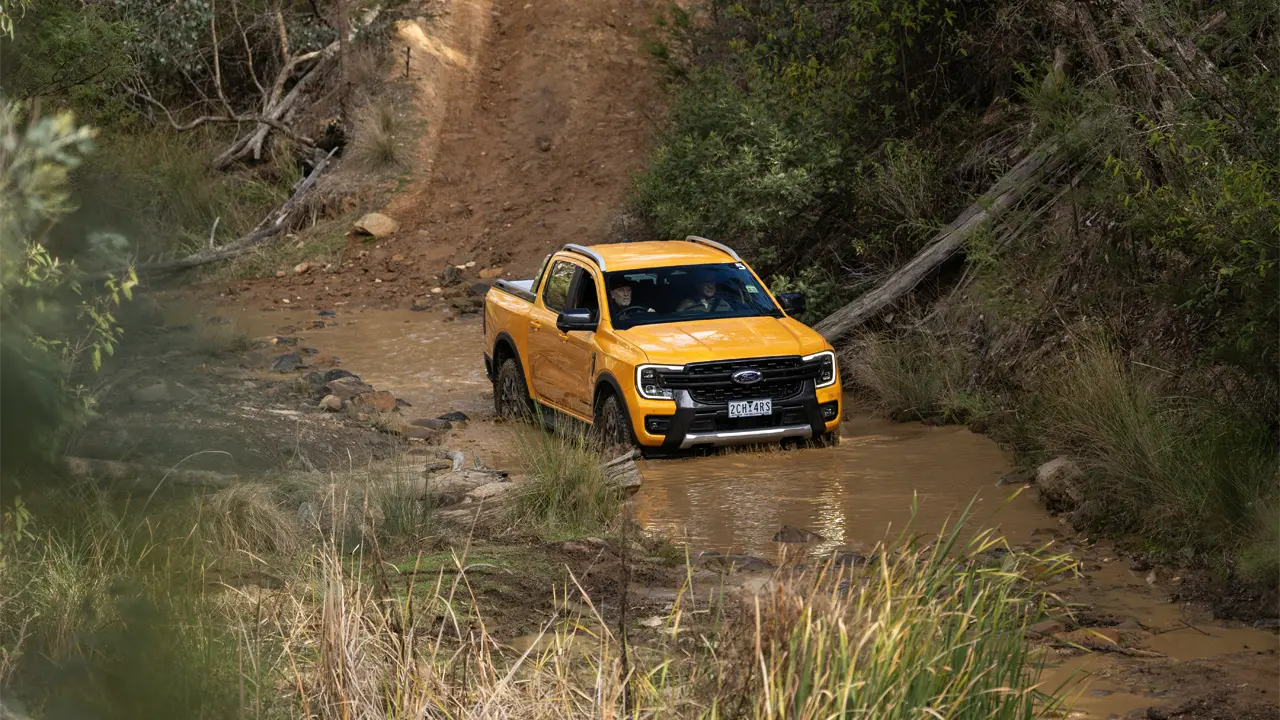
Off road, Ford’s regular suite of driver assistance systems – such as smooth hill descent control and off-road cameras – meld well with the new powertrain. The PHEV is a capable machine with a good load of torque for climbing a 60% gradient in electric mode, Auto 4WD and rear differential locked. When needed in the rough, and with extra throttle, the petrol motor powers up. But it can also creep through the scrub in whisper-quiet, all-electric mode. For the hard yards, Auto EV works with 4WD low.
The Ford Ranger PHEV is not the cheapest hybrid 4WD ute, but is a clever and competent machine – a refined package engineered and developed in Australia that quietly edges out diesel variants in some respects. Expensive maybe, but very impressive.
This story excerpt is from issue #163
Outback Magazine: Oct/Nov 2025